# Golang Kinesis Consumer
Kinesis consumer applications written in Go. This library is intended to be a lightweight wrapper around the Kinesis API to read records, save checkpoints (with swappable backends), and gracefully recover from network errors.
__NOTE(1):__ With the release of [Kinesis to Firehose](http://docs.aws.amazon.com/firehose/latest/dev/writing-with-kinesis-streams.html) it's possible to archive data directly to S3, Redshift, or Elasticsearch without running a consumer application.
__NOTE(2):__ To avoid managing checkpoints and running any infrastructure it's also possible to [Process Kinensis Streams with Golang and AWS Lambda](https://medium.com/@harlow/processing-kinesis-streams-w-aws-lambda-and-golang-264efc8f979a)._
## Installation
Get the package source:
$ go get github.com/harlow/kinesis-consumer
## Overview
The consumer leverages a handler func that accepts a Kinesis record. The `Scan` method will consume all shards concurrently and call the callback func as it receives records from the stream.
```go
import(
// ...
consumer "github.com/harlow/kinesis-consumer"
checkpoint "github.com/harlow/kinesis-consumer/checkpoint/redis"
)
func main() {
var (
app = flag.String("app", "", "App name")
stream = flag.String("stream", "", "Stream name")
)
flag.Parse()
// new checkpoint
ck, err := checkpoint.New(*app, *stream)
if err != nil {
log.Fatalf("checkpoint error: %v", err)
}
// new consumer
c, err := consumer.New(ck, *app, *stream)
if err != nil {
log.Fatalf("consumer error: %v", err)
}
// scan stream
err = c.Scan(context.TODO(), func(r *consumer.Record) bool {
fmt.Println(string(r.Data))
return true // continue scanning
})
if err != nil {
log.Fatalf("scan error: %v", err)
}
// Note: If you need to aggregate based on a specific shard the `ScanShard`
// method should be leverged instead.
}
```
## Checkpoint
To record the progress of the consumer in the stream we use a checkpoint to store the last sequence number the consumer has read from a particular shard.
This will allow consumers to re-launch and pick up at the position in the stream where they left off.
The uniq identifier for a consumer is `[appName, streamName, shardID]`
 There are currently two storage types for checkpoints:
### Redis Checkpoint
The Redis checkpoint requries App Name, and Stream Name:
```go
import checkpoint "github.com/harlow/kinesis-consumer/checkpoint/redis"
// redis checkpoint
ck, err := checkpoint.New(appName, streamName)
if err != nil {
log.Fatalf("new checkpoint error: %v", err)
}
```
### DynamoDB Checkpoint
The DynamoDB checkpoint requires Table Name, App Name, and Stream Name:
```go
import checkpoint "github.com/harlow/kinesis-consumer/checkpoint/ddb"
// ddb checkpoint
ck, err := checkpoint.New(tableName, appName, streamName)
if err != nil {
log.Fatalf("new checkpoint error: %v", err)
}
```
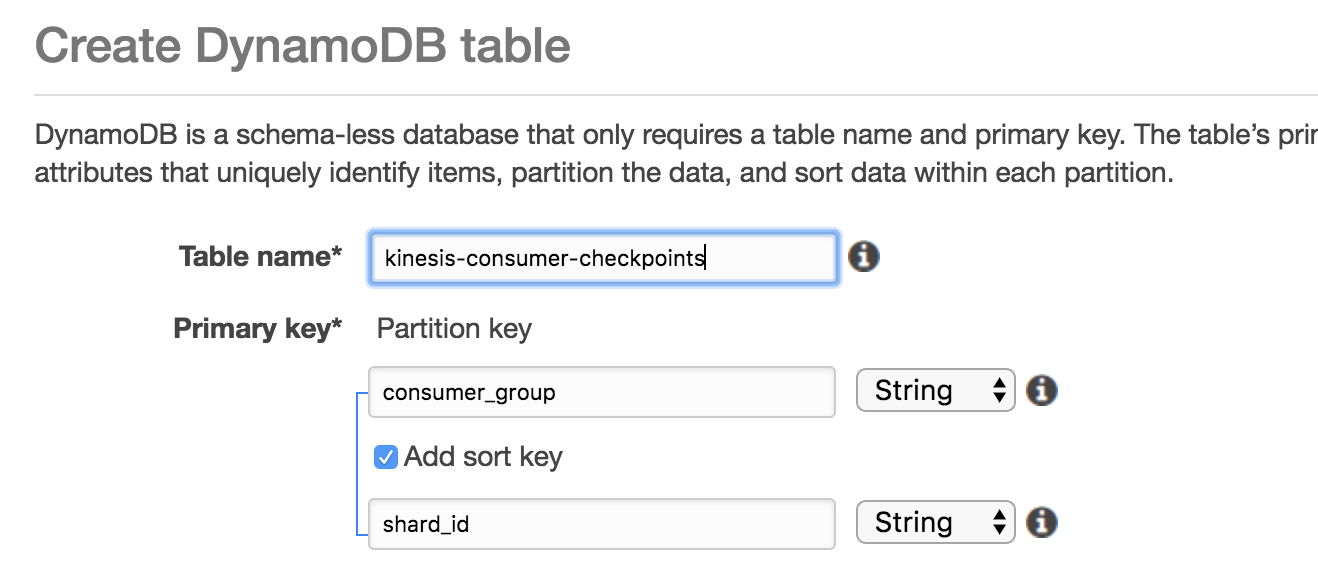
To leverage the DDB checkpoint we'll also need to create a table:
There are currently two storage types for checkpoints:
### Redis Checkpoint
The Redis checkpoint requries App Name, and Stream Name:
```go
import checkpoint "github.com/harlow/kinesis-consumer/checkpoint/redis"
// redis checkpoint
ck, err := checkpoint.New(appName, streamName)
if err != nil {
log.Fatalf("new checkpoint error: %v", err)
}
```
### DynamoDB Checkpoint
The DynamoDB checkpoint requires Table Name, App Name, and Stream Name:
```go
import checkpoint "github.com/harlow/kinesis-consumer/checkpoint/ddb"
// ddb checkpoint
ck, err := checkpoint.New(tableName, appName, streamName)
if err != nil {
log.Fatalf("new checkpoint error: %v", err)
}
```
To leverage the DDB checkpoint we'll also need to create a table:
 ## Options
The consumer allows the following optional overrides:
* Kinesis Client
* Logger
```go
// new kinesis client
svc := kinesis.New(session.New(aws.NewConfig()))
// new consumer with custom client
c, err := consumer.New(
consumer,
streamName,
consumer.WithClient(svc),
)
```
## Logging
The package defaults to `ioutil.Discard` which will silence log output. This can be overridden with the preferred logging strategy:
```go
func main() {
// ...
// logger
logger := log.New(os.Stdout, "consumer-example: ", log.LstdFlags)
// consumer
c, err := consumer.New(checkpoint, appName, streamName, consumer.WithLogger(logger))
}
```
## Contributing
Please see [CONTRIBUTING.md] for more information. Thank you, [contributors]!
[LICENSE]: /MIT-LICENSE
[CONTRIBUTING.md]: /CONTRIBUTING.md
## License
Copyright (c) 2015 Harlow Ward. It is free software, and may
be redistributed under the terms specified in the [LICENSE] file.
[contributors]: https://github.com/harlow/kinesis-connectors/graphs/contributors
> [www.hward.com](http://www.hward.com) ·
> GitHub [@harlow](https://github.com/harlow) ·
> Twitter [@harlow_ward](https://twitter.com/harlow_ward)
## Options
The consumer allows the following optional overrides:
* Kinesis Client
* Logger
```go
// new kinesis client
svc := kinesis.New(session.New(aws.NewConfig()))
// new consumer with custom client
c, err := consumer.New(
consumer,
streamName,
consumer.WithClient(svc),
)
```
## Logging
The package defaults to `ioutil.Discard` which will silence log output. This can be overridden with the preferred logging strategy:
```go
func main() {
// ...
// logger
logger := log.New(os.Stdout, "consumer-example: ", log.LstdFlags)
// consumer
c, err := consumer.New(checkpoint, appName, streamName, consumer.WithLogger(logger))
}
```
## Contributing
Please see [CONTRIBUTING.md] for more information. Thank you, [contributors]!
[LICENSE]: /MIT-LICENSE
[CONTRIBUTING.md]: /CONTRIBUTING.md
## License
Copyright (c) 2015 Harlow Ward. It is free software, and may
be redistributed under the terms specified in the [LICENSE] file.
[contributors]: https://github.com/harlow/kinesis-connectors/graphs/contributors
> [www.hward.com](http://www.hward.com) ·
> GitHub [@harlow](https://github.com/harlow) ·
> Twitter [@harlow_ward](https://twitter.com/harlow_ward)