| checkpoint | ||
| examples | ||
| .gitignore | ||
| CHANGELOG.md | ||
| consumer.go | ||
| CONTRIBUTING.md | ||
| Gopkg.lock | ||
| Gopkg.toml | ||
| MIT-LICENSE | ||
| README.md | ||

Golang Kinesis Consumer
Kinesis consumer applications written in Go. This library is intended to be a lightweight wrapper around the Kinesis API to read records, save checkpoints (with swappable backends), and gracefully recover from network errors.
NOTE: With the release of Kinesis to Firehose it's possible to archive data directly to S3, Redshift, or Elasticsearch without running a consumer application.
UPDATE: To avoid managing checkpoints and running any infrastructure it's also possible to Process Kinensis Streams with Golang and Lambda.
Installation
Get the package source:
$ go get github.com/harlow/kinesis-consumer
Overview
The consumer leverages a handler func that accepts a Kinesis record. The Scan method will consume all shards concurrently and call the callback func as it receives records from the stream.
import(
	// ...
	consumer "github.com/harlow/kinesis-consumer"
	checkpoint "github.com/harlow/kinesis-consumer/checkpoint/redis"
)

func main() {
	var (
		app    = flag.String("app", "", "App name")
		stream = flag.String("stream", "", "Stream name")
	)
	flag.Parse()

	// new checkpoint
	ck, err := checkpoint.New(*app, *stream)
	if err != nil {
		log.Fatalf("checkpoint error: %v", err)
	}

	// new consumer
	c, err := consumer.New(ck, *app, *stream)
	if err != nil {
		log.Fatalf("consumer error: %v", err)
	}

	// scan stream
	err = c.Scan(context.TODO(), func(r *consumer.Record) bool {
		fmt.Println(string(r.Data))
		return true // continue scanning
	})
	if err != nil {
		log.Fatalf("scan error: %v", err)
	}

	// Note: If you need to aggregate based on a specific shard the `ScanShard`
	// method should be leverged instead.
}
Checkpoint
To record the progress of the consumer in the stream we use a checkpoint to store the last sequence number the consumer has read from a particular shard.
This will allow consumers to re-launch and pick up at the position in the stream where they left off.
The uniq identifier for a consumer is [appName, streamName, shardID]

There are currently two storage types for checkpoints:
Redis Checkpoint
The Redis checkpoint requries App Name, and Stream Name:
import checkpoint "github.com/harlow/kinesis-consumer/checkpoint/redis"

// redis checkpoint
ck, err := checkpoint.New(appName, streamName)
if err != nil {
	log.Fatalf("new checkpoint error: %v", err)
}
DynamoDB Checkpoint
The DynamoDB checkpoint requires Table Name, App Name, and Stream Name:
import checkpoint "github.com/harlow/kinesis-consumer/checkpoint/ddb"

// ddb checkpoint
ck, err := checkpoint.New(tableName, appName, streamName)
if err != nil {
	log.Fatalf("new checkpoint error: %v", err)
}
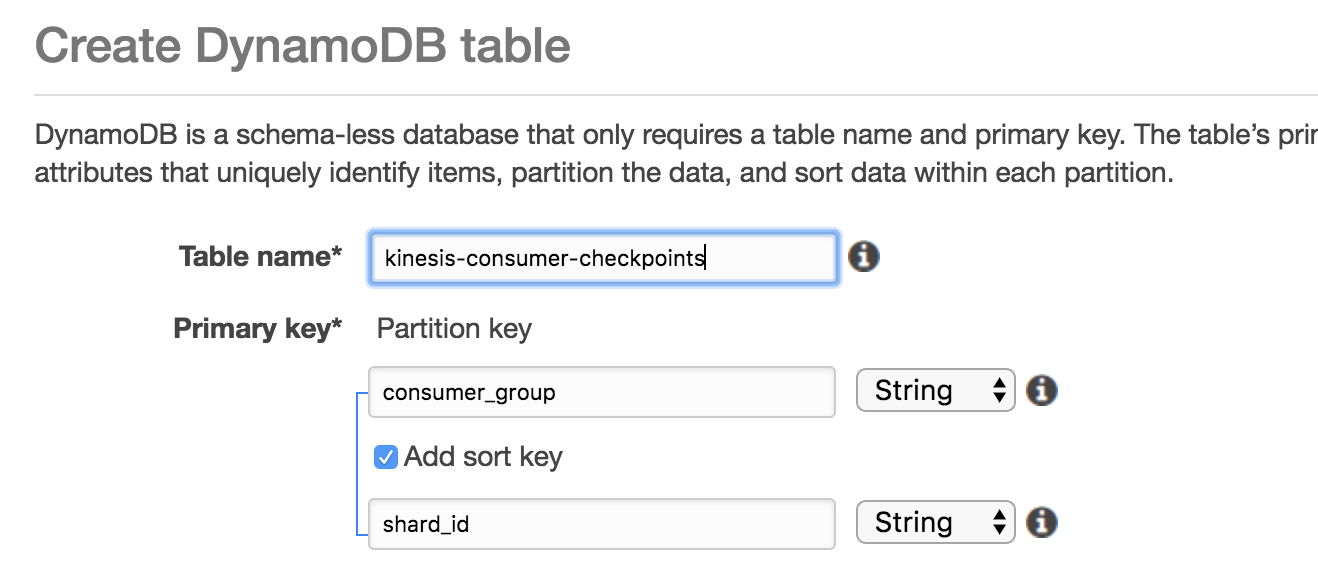
To leverage the DDB checkpoint we'll also need to create a table:
Options
The consumer allows the following optional overrides:
- Kinesis Client
- Logger
// new kinesis client
svc := kinesis.New(session.New(aws.NewConfig()))

// new consumer with custom client
c, err := consumer.New(
	consumer,
	streamName,
	consumer.WithClient(svc),
)
Logging
The package defaults to ioutil.Discard so swallow all logs. This can be customized with the preferred logging strategy:
func main() {
	// ...

	// logger
	logger := log.New(os.Stdout, "consumer-example: ", log.LstdFlags)

	// consumer
	c, err := consumer.New(checkpoint, appName, streamName, consumer.WithLogger(logger))
}
Contributing
Please see CONTRIBUTING.md for more information. Thank you, contributors!
License
Copyright (c) 2015 Harlow Ward. It is free software, and may be redistributed under the terms specified in the LICENSE file.
www.hward.com · GitHub @harlow · Twitter @harlow_ward