Signal handlers process created signals to *do something with them* (analyse them, write them to console/file/queue/db, etc.).
# Included handlers
The following handlers are included out-the-box:
| Name | Platform | Writes signals to | Writes signals as |
| :---------------------------------------------------------------------------------------------------------------------------------------- | :------- | :------------------------------------------------------------------------------------------------------------- | :------------------------------------------------------------------------------- |
| [`handler:console`](https://cljdoc.org/d/com.taoensso/telemere/CURRENT/api/taoensso.telemere#handler:console) | Clj | `*out*` or `*err*` | String ([edn](https://github.com/edn-format/edn), JSON, formatted, etc.) |
| [`handler:console`](https://cljdoc.org/d/com.taoensso/telemere/CURRENT/api/taoensso.telemere#handler:console) | Cljs | Browser console | String ([edn](https://github.com/edn-format/edn), JSON, formatted, etc.) |
| [`handler:console-raw`](https://cljdoc.org/d/com.taoensso/telemere/CURRENT/api/taoensso.telemere#handler:console-raw) | Cljs | Browser console | Raw data (for [cljs-devtools](https://github.com/binaryage/cljs-devtools), etc.) |
| [`handler:file`](https://cljdoc.org/d/com.taoensso/telemere/CURRENT/api/taoensso.telemere#handler:file) | Clj | File/s on disk | String ([edn](https://github.com/edn-format/edn), JSON, formatted, etc.) |
| [`handler:open-telemetry-logger`](https://cljdoc.org/d/com.taoensso/telemere/CURRENT/api/taoensso.telemere#handler:open-telemetry-logger) | Clj | [OpenTelemetry](https://opentelemetry.io/) [Java client](https://github.com/open-telemetry/opentelemetry-java) | [LogRecord](https://opentelemetry.io/docs/specs/otel/logs/data-model/) |
- See relevant docstrings (links above) for more info.
- See section [8-Community](8-Community.md) for additional handlers.
# Configuring handlers
There's two kinds of config relevant to all signal handlers:
1. **Dispatch** opts (common to all handlers), and
2. **Handler-specific** opts
## Dispatch opts
Dispatch opts includes dispatch priority, handler filtering, handler middleware, queue semantics, back-pressure opts, etc.
This is all specified when calling [`add-handler!`](https://cljdoc.org/d/com.taoensso/telemere/CURRENT/api/taoensso.telemere#add-handler!) - and documented there.
Note that handler middleware in particular is an often overlooked but powerful feature, allowing you to arbitrarily transform and/or filter every [signal map](https://cljdoc.org/d/com.taoensso/telemere/CURRENT/api/taoensso.telemere#help:signal-content) before it is given to the handler.
## Handler-specific opts
Handler-specific opts are specified when calling a particular **handler constructor** (like [`handler:console`](https://cljdoc.org/d/com.taoensso/telemere/CONSOLE/api/taoensso.telemere#handler:console)) - and documented by the constructor.
Note that it's common for Telemere handlers to be customized by providing *Clojure/Script functions* to the relevant handler constructor call.
See the [utils namespace](https://cljdoc.org/d/com.taoensso/telemere/CURRENT/api/taoensso.telemere.utils) for tools useful for customizing and writing signal handlers.
### Example
The standard Clj/s console handler ([`handler:console`](https://cljdoc.org/d/com.taoensso/telemere/CURRENT/api/taoensso.telemere#handler:console)) writes signals **as strings** to `*out*`/`*err` or browser console.
By default it writes formatted strings intended for human consumption:
```clojure
;; Create a test signal
(def my-signal
(t/with-signal
(t/log! {:id ::my-id, :data {:x1 :x2}} "My message")))
;; Create console handler with default opts (writes formatted string)
(def my-handler (t/handler:console))
;; Test handler, remember it's just a (fn [signal])
(my-handler my-signal) ; =>
;; 2024-04-11T10:54:57.202869Z INFO LOG Schrebermann.local examples(56,1) ::my-id - My message
;; data: {:x1 :x2}
```
To instead writes signals as edn:
```clojure
;; Create console which writes edn
(def my-handler
(t/handler:console
{:format-signal-fn (taoensso.telemere.utils/format-signal->edn-fn)}))
(my-handler my-signal) ; =>
;; {:inst #inst "2024-04-11T10:54:57.202869Z", :msg_ "My message", :ns "examples", ...}
```
To instead writes signals as JSON:
```clojure
;; Create console which writes JSON
(def my-handler
(t/handler:console
{:format-signal-fn
(taoensso.telemere.utils/format-signal->json-fn
{:pr-json-fn jsonista.core/write-value-as-string})}))
(my-handler my-signal) ; =>
;; {"inst":"2024-04-11T10:54:57.202869Z","msg_":"My message","ns":"examples", ...}
```
Note that when writing JSON with Clojure, you *must* specify a `pr-json-fn`. This lets you plug in the JSON serializer of your choice ([jsonista](https://github.com/metosin/jsonista) is my default recommendation).
# Managing handlers
See [`help:signal-handlers`](https://cljdoc.org/d/com.taoensso/telemere/CURRENT/api/taoensso.telemere#help:signal-handlers) for info on handler management.
## Managing handlers on startup
Want to add or remove a particular handler when your application starts?
Just make an appropriate call to [`add-handler!`](https://cljdoc.org/d/com.taoensso/telemere/CURRENT/api/taoensso.telemere#add-handler!) or [`remove-handler!`](https://cljdoc.org/d/com.taoensso/telemere/CURRENT/api/taoensso.telemere#remove-handler!).
## System-level config
If you want to manage handlers **conditionally** based on **system-level config** (e.g. JVM prop, ENV var, or classpath resource) - Telemere provides the highly flexible [`get-env`](https://cljdoc.org/d/com.taoensso/telemere/CURRENT/api/taoensso.telemere#get-env) util.
Use this to easily check your own cross-platform system config, and make whatever conditional handler management decisions you'd like.
# Writing handlers
Writing your own signal handlers for Telemere is straightforward, and a reasonable choice if you prefer customizing behaviour that way, or want to write signals to a DB/format/service for which a ready-made handler isn't available.
Remember that signals are just plain Clojure/Script [maps](https://cljdoc.org/d/com.taoensso/telemere/CURRENT/api/taoensso.telemere#help:signal-content), and handlers just plain Clojure/Script functions that do something with those maps.
Here's a simple Telemere handler:
```clojure
(fn my-handler [signal] (println signal))
```
For more complex cases, or for handlers that you want to make available for use by other folks, here's the general template that Telemere uses for all its included handlers:
```clojure
(defn handler:my-handler ; Note naming convention
"Returns a (fn handler [signal] that:
- Does something.
Options:
`:option1` - Description
`:option2` - Description"
([] (handler:my-handler nil)) ; Use default opts
([{:as constructor-opts}]
;; Do expensive prep outside returned handler fn whenever possible -
;; i.e. at (one-off) construction time rather than handling time.
(let []
(fn a-handler:my-handler ; Note naming convention
;; Shutdown arity - called by Telemere exactly once when the handler is
;; to be shut down. This is your opportunity to finalize/free resources, etc.
([])
;; Main arity - called by Telemere whenever the handler should handle the
;; given signal. Never called after shutdown.
([signal]
;; TODO Do something with given signal
)))))
```
- See [`help:signal-content`](https://cljdoc.org/d/com.taoensso/telemere/CURRENT/api/taoensso.telemere#help:signal-content) for signal map content.
- See the [utils namespace](https://cljdoc.org/d/com.taoensso/telemere/CURRENT/api/taoensso.telemere.utils) for tools useful for customizing and writing signal handlers.
- See section [8-Community](8-Community.md) for PRs to link to community-authored handlers.
# Example output
```clojure
(t/log! {:id ::my-id, :data {:x1 :x2}} "My message") =>
```
## Clj console handler
String output:
```
2024-04-11T10:54:57.202869Z INFO LOG Schrebermann.local examples(56,1) ::my-id - My message
data: {:x1 :x2}
```
## Cljs console handler
Chrome console:
 ## Cljs raw console handler
Chrome console, with [cljs-devtools](https://github.com/binaryage/cljs-devtools):
## Cljs raw console handler
Chrome console, with [cljs-devtools](https://github.com/binaryage/cljs-devtools):
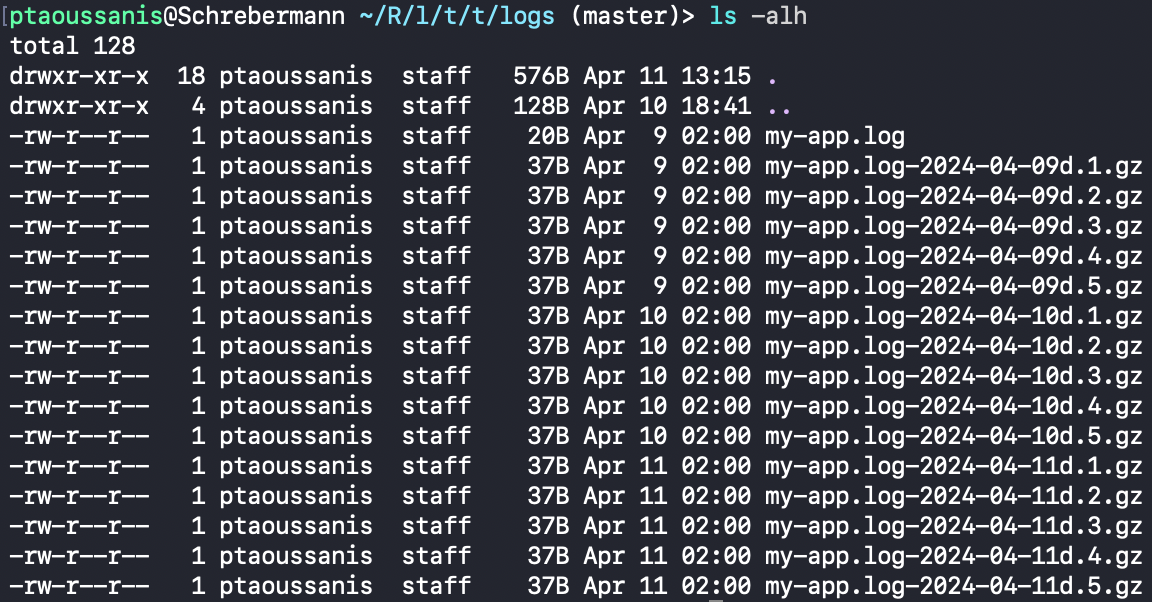
 ## Clj file handler
MacOS terminal:
## Clj file handler
MacOS terminal: