 # Introduction
Telemere is a **structured telemetry** library and next-generation replacement for [Timbre](https://www.taoensso.com/timbre). It helps enable the creation of Clojure/Script systems that are highly **observable**, **robust**, and **debuggable**.
Its key function is to help:
1. **Capture data** in your running Clojure/Script programs, and
2. **Facilitate processing** of that data into **useful information / insight**.
## Signals
The basic unit of data in Telemere is the **signal**.
Signals include **traditional log messages**, **structured log messages**, and **events**. Telemere doesn't make a hard distinction between these - *they're all just signals* with [various attributes](https://cljdoc.org/d/com.taoensso/telemere/CURRENT/api/taoensso.telemere#help:signal-content).
And they're represented by plain **Clojure/Script maps** with those attributes (keys).
Fundamentally **all signals**:
- Occur or are observed at a particular **location** in your code (file, namespace, line, column).
- Occur or are observed *within* a particular **program state** / context.
- Convey something of value *about* that **program state** / context.
Signals may be *independently* valuable, valuable *in the aggregate* (e.g. statistically), or valuable *in association* with other related signals (e.g. while tracing the flow of some logical activity).
## Functionality
The basic tools of Telemere are:
1. **Signal creators** to conditionally *create* signal maps at points in your code.
2. **Signal handlers** to conditionally *handle* those signal maps (analyse, write to
console/file/queue/db, etc.).
This is just a generalization of **traditional logging** which:
- Conditionally creates **message strings** at points in your code.
- Usually *dumps* those message strings somewhere for future parsing by human eyes or automated tools.
## Data types and structures
The parsing of traditional log messages is often expensive, fragile, and lossy. So a key principle of **structured logging** is to **avoid parsing**, by instead **preserving data types and structures** whenever possible.
Telemere embraces this principle by making such preservation *natural and convenient*.
## Noise reduction
Not all data is equally valuable.
Too much low-value data is often actively *harmful*: expensive to process, to store, and to query. Adding noise just interferes with better data, harming your ability to understand your system.
Telemere embraces this principle by making **effective filtering** likewise *natural and convenient*:
# Introduction
Telemere is a **structured telemetry** library and next-generation replacement for [Timbre](https://www.taoensso.com/timbre). It helps enable the creation of Clojure/Script systems that are highly **observable**, **robust**, and **debuggable**.
Its key function is to help:
1. **Capture data** in your running Clojure/Script programs, and
2. **Facilitate processing** of that data into **useful information / insight**.
## Signals
The basic unit of data in Telemere is the **signal**.
Signals include **traditional log messages**, **structured log messages**, and **events**. Telemere doesn't make a hard distinction between these - *they're all just signals* with [various attributes](https://cljdoc.org/d/com.taoensso/telemere/CURRENT/api/taoensso.telemere#help:signal-content).
And they're represented by plain **Clojure/Script maps** with those attributes (keys).
Fundamentally **all signals**:
- Occur or are observed at a particular **location** in your code (file, namespace, line, column).
- Occur or are observed *within* a particular **program state** / context.
- Convey something of value *about* that **program state** / context.
Signals may be *independently* valuable, valuable *in the aggregate* (e.g. statistically), or valuable *in association* with other related signals (e.g. while tracing the flow of some logical activity).
## Functionality
The basic tools of Telemere are:
1. **Signal creators** to conditionally *create* signal maps at points in your code.
2. **Signal handlers** to conditionally *handle* those signal maps (analyse, write to
console/file/queue/db, etc.).
This is just a generalization of **traditional logging** which:
- Conditionally creates **message strings** at points in your code.
- Usually *dumps* those message strings somewhere for future parsing by human eyes or automated tools.
## Data types and structures
The parsing of traditional log messages is often expensive, fragile, and lossy. So a key principle of **structured logging** is to **avoid parsing**, by instead **preserving data types and structures** whenever possible.
Telemere embraces this principle by making such preservation *natural and convenient*.
## Noise reduction
Not all data is equally valuable.
Too much low-value data is often actively *harmful*: expensive to process, to store, and to query. Adding noise just interferes with better data, harming your ability to understand your system.
Telemere embraces this principle by making **effective filtering** likewise *natural and convenient*:
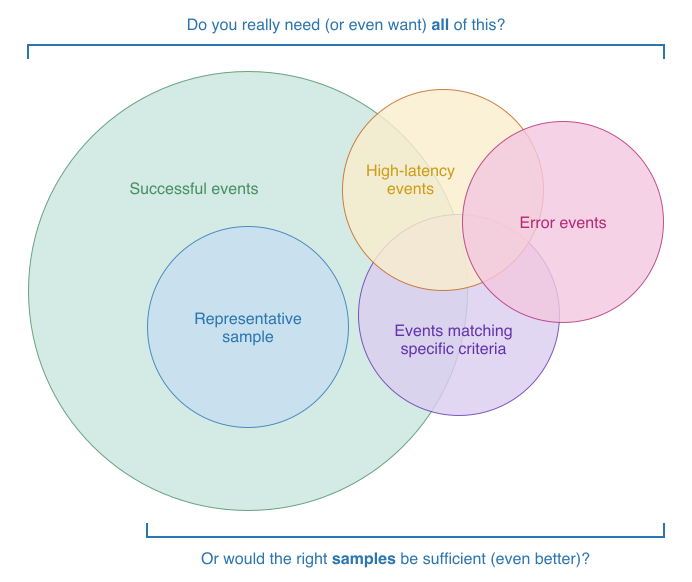 > Telemere uses the term **filtering** as the superset of both random sampling and other forms of data exclusion/reduction.
## Structured telemetry
To conclude- Telemere handles **structured and traditional logging**, **tracing**, and **basic performance monitoring** with a simple unified API that:
- Preserves data types and structures with **rich signals**, and
- Offers effective noise reduction with **signal filtering**.
Its name is a combination of _telemetry_ and _telomere_:
> *Telemetry* derives from the Greek *tele* (remote) and *metron* (measure). It refers to the collection of *in situ* (in position) data, for transmission to other systems for monitoring/analysis. *Logs* are the most common form of software telemetry. So think of telemetry as the *superset of logging-like activities* that help monitor and understand (software) systems.
> *Telomere* derives from the Greek *télos* (end) and *méros* (part). It refers to a genetic feature commonly found at the end of linear chromosomes that helps to protect chromosome integrity.
# Setup
Add the [relevant dependency](../#latest-releases) to your project:
```clojure
Leiningen: [com.taoensso/telemere "x-y-z"] ; or
deps.edn: com.taoensso/telemere {:mvn/version "x-y-z"}
```
And setup your namespace imports:
```clojure
(ns my-app (:require [taoensso.telemere :as t]))
```
# Default config
Telemere is configured sensibly out-the-box.
See section [3-Config](./3-Config) for customization.
**Default minimum level**: `:info` (signals with lower levels will no-op).
**Default signal handlers**:
> Signal handlers process created signals to *do something with them* (analyse them, write them to console/file/queue/db, etc.)
| Platform | Condition | Handler
| --- | --- | ---
| Clj | Always | [Console handler](https://cljdoc.org/d/com.taoensso/telemere/CURRENT/api/taoensso.telemere#handler:console) that prints signals to `*out*` or `*err*`.
| Cljs | Always | [Console handler](https://cljdoc.org/d/com.taoensso/telemere/CURRENT/api/taoensso.telemere#handler:console) that prints signals to the **browser console**.
| Clj | [OpenTelemetry API](https://mvnrepository.com/artifact/io.opentelemetry/opentelemetry-api) present | [OpenTelemetry handler](https://cljdoc.org/d/com.taoensso/telemere/CURRENT/api/taoensso.telemere#handler:open-telemetry-logger) that emits signals as log records to a configured [`LoggerProvider`](https://opentelemetry.io/docs/specs/otel/logs/sdk/#loggerprovider).
**Default signal intakes**:
> Telemere can create signals from relevant **external API calls**, etc.
| Platform | Condition | Signals from
| --- | --- | ---
| Clj | [SLF4J API](https://mvnrepository.com/artifact/org.slf4j/slf4j-api) and [Telemere SLF4J backend](https://clojars.org/com.taoensso/slf4j-telemere) present | [SLF4J](https://www.slf4j.org/) logging calls.
| Clj | [clojure.tools.logging](https://mvnrepository.com/artifact/org.clojure/tools.logging) present and [`tools-logging->telemere!`](https://cljdoc.org/d/com.taoensso/telemere/CURRENT/api/taoensso.telemere#tools-logging-%3Etelemere!) called | [clojure.tools.logging](https://github.com/clojure/tools.logging) logging calls.
| Clj | [`streams->telemere!`](https://cljdoc.org/d/com.taoensso/telemere/CURRENT/api/taoensso.telemere#streams-%3Etelemere!) called | Output to `System/out` and `System/err` streams.
Run [`check-intakes`](https://cljdoc.org/d/com.taoensso/telemere/CURRENT/api/taoensso.telemere#check-intakes) to help verify/debug:
```clojure
(check-intakes) ; =>
{:tools-logging {:present? false}
:slf4j {:sending->telemere? true, :telemere-receiving? true}
:system/out {:sending->telemere? false, :telemere-receiving? false}
:system/err {:sending->telemere? false, :telemere-receiving? false}}
```
# Usage
## Create signals
Use whichever signal creator is most convenient for your needs:
| Name | Signal kind | Main arg | Optional arg | Returns
:-- | :-- | :-- | :-- | :--
| [`log!`](https://cljdoc.org/d/com.taoensso/telemere/CURRENT/api/taoensso.telemere#log!) | `:log` | `msg` | `opts`/`level` | Signal allowed?
| [`event!`](https://cljdoc.org/d/com.taoensso/telemere/CURRENT/api/taoensso.telemere#event!) | `:event` | `id` | `opts`/`level` | Signal allowed?
| [`error!`](https://cljdoc.org/d/com.taoensso/telemere/CURRENT/api/taoensso.telemere#error!) | `:error` | `error` | `opts`/`id` | Given error
| [`trace!`](https://cljdoc.org/d/com.taoensso/telemere/CURRENT/api/taoensso.telemere#trace!) | `:trace` | `form` | `opts`/`id` | Form result
| [`spy!`](https://cljdoc.org/d/com.taoensso/telemere/CURRENT/api/taoensso.telemere#spy!) | `:spy` | `form` | `opts`/`level` | Form result
| [`catch->error!`](https://cljdoc.org/d/com.taoensso/telemere/CURRENT/api/taoensso.telemere#catch-%3Eerror!) | `:error` | `form` | `opts`/`id` | Form value or given fallback
| [`signal!`](https://cljdoc.org/d/com.taoensso/telemere/CURRENT/api/taoensso.telemere#signal!) | `` | `opts` | - | Depends on opts
- See [`help:signal-creators`](https://cljdoc.org/d/com.taoensso/telemere/CURRENT/api/taoensso.telemere#help:signal-creators) for more info on signal creators.
- See [`help:signal-options`](https://cljdoc.org/d/com.taoensso/telemere/CURRENT/api/taoensso.telemere#help:signal-options) for signal options (shared by all creators).
- See relevant docstrings (links above) for usage info.
- See [examples.cljc](https://github.com/taoensso/telemere/blob/master/examples.cljc) for REPL-ready examples.
## Check signals
Use the [`with-signal`](https://cljdoc.org/d/com.taoensso/telemere/CURRENT/api/taoensso.telemere#with-signal) or (advanced) [`with-signals`](https://cljdoc.org/d/com.taoensso/telemere/CURRENT/api/taoensso.telemere#with-signals) utils to help test/debug the signals that you're creating:
```clojure
(t/with-signal
(t/log!
{:let [x "x"]
:data {:x x}}
["My msg:" x]))
;; => {:keys [ns inst data msg_ ...]} ; The signal
```
- [`with-signal`](https://cljdoc.org/d/com.taoensso/telemere/CURRENT/api/taoensso.telemere#with-signal) will return the **last** signal created by the given form.
- [`with-signals`](https://cljdoc.org/d/com.taoensso/telemere/CURRENT/api/taoensso.telemere#with-signals) will return **all** signals created by the given form.
Both have several options, see their docstrings (links above) for details.
## Filter signals
A signal will be provided to a handler iff ALL of the following are true:
1. Signal **creation** is allowed by **compile-time** filter config
2. Signal **creation** is allowed by **runtime** filter config
3. Signal **handling** is allowed by **handler** filter config
4. Signal **middleware** does not suppress the signal (return nil)
5. Handler **middleware** does not suppress the signal (return nil)
For 1-3, filtering may depend on (in order):
Sample rate → namespace → kind → id → level → when form/fn → rate limit
Quick examples of some basic filtering:
```clojure
(t/set-min-level! :info) ; Set global minimum level
(t/with-signal (t/event! ::my-id1 :info)) ; => {:keys [inst id ...]}
(t/with-signal (t/event! ::my-id1 :debug)) ; => nil (signal not allowed)
(t/with-min-level :trace ; Override global minimum level
(t/with-signal (t/event! ::my-id1 :debug))) ; => {:keys [inst id ...]}
;; Deny all signals in matching namespaces
(t/set-ns-filter! {:deny "some.nosy.namespace.*"})
```
- Filtering is always O(1), except for rate limits which are O(n_windows).
- Sample rates are *multiplicative*: if a signal is created with *20%* sampling and a handler handles *50%* of given signals, then *10%* of possible signals will be handled. This multiplicative rate is helpfully reflected in each signal's final `:sample-rate` value.
- See [`help:signal-flow`](https://cljdoc.org/d/com.taoensso/telemere/CURRENT/api/taoensso.telemere#help:signal-flow) for internal docs on signal flow.
- See section [2-Architecture](./2-Architecture) for a flowchart / visual aid.
Runtime signal filters can be configured with:
| Global | Dynamic | Filters by
| :-- | :-- | :--
| [`set-kind-filter!`](https://cljdoc.org/d/com.taoensso/telemere/CURRENT/api/taoensso.telemere#set-kind-filter!) | [`with-kind-filter`](https://cljdoc.org/d/com.taoensso/telemere/CURRENT/api/taoensso.telemere#with-kind-filter) | Signal kind (`:log`, `:event`, etc.)
| [`set-ns-filter!`](https://cljdoc.org/d/com.taoensso/telemere/CURRENT/api/taoensso.telemere#set-ns-filter!) | [`with-ns-filter`](https://cljdoc.org/d/com.taoensso/telemere/CURRENT/api/taoensso.telemere#with-ns-filter) | Signal namespace
| [`set-id-filter!`](https://cljdoc.org/d/com.taoensso/telemere/CURRENT/api/taoensso.telemere#set-id-filter!) | [`with-id-filter`](https://cljdoc.org/d/com.taoensso/telemere/CURRENT/api/taoensso.telemere#with-id-filter) | Signal id
| [`set-min-level`](https://cljdoc.org/d/com.taoensso/telemere/CURRENT/api/taoensso.telemere#set-min-level) | [`with-min-level`](https://cljdoc.org/d/com.taoensso/telemere/CURRENT/api/taoensso.telemere#with-min-level) | Signal level (minimum can be specified by kind and/or ns)
- See relevant docstrings (links above) for usage info.
- Compile-time filters are controlled by system-level config, see section [3-Config](./3-Config).
# Internal help
Telemere includes extensive internal help docstrings:
| Var | Help with
| :-- | :--
| [`help:signal-creators`](https://cljdoc.org/d/com.taoensso/telemere/CURRENT/api/taoensso.telemere#help:signal-creators) | List of signal creators
| [`help:signal-options`](https://cljdoc.org/d/com.taoensso/telemere/CURRENT/api/taoensso.telemere#help:signal-options) | Options for signal creators
| [`help:signal-content`](https://cljdoc.org/d/com.taoensso/telemere/CURRENT/api/taoensso.telemere#help:signal-content) | Signal map content
| [`help:signal-flow`](https://cljdoc.org/d/com.taoensso/telemere/CURRENT/api/taoensso.telemere#help:signal-flow) | Ordered flow from signal creation to handling
| [`help:signal-filters`](https://cljdoc.org/d/com.taoensso/telemere/CURRENT/api/taoensso.telemere#help:signal-filters) | API for configuring signal filters
| [`help:signal-handlers`](https://cljdoc.org/d/com.taoensso/telemere/CURRENT/api/taoensso.telemere#help:signal-handlers) | API for configuring signal handlers
| [`help:signal-formatters`](https://cljdoc.org/d/com.taoensso/telemere/CURRENT/api/taoensso.telemere#help:signal-formatters) | Signal formatters for use by handlers
> Telemere uses the term **filtering** as the superset of both random sampling and other forms of data exclusion/reduction.
## Structured telemetry
To conclude- Telemere handles **structured and traditional logging**, **tracing**, and **basic performance monitoring** with a simple unified API that:
- Preserves data types and structures with **rich signals**, and
- Offers effective noise reduction with **signal filtering**.
Its name is a combination of _telemetry_ and _telomere_:
> *Telemetry* derives from the Greek *tele* (remote) and *metron* (measure). It refers to the collection of *in situ* (in position) data, for transmission to other systems for monitoring/analysis. *Logs* are the most common form of software telemetry. So think of telemetry as the *superset of logging-like activities* that help monitor and understand (software) systems.
> *Telomere* derives from the Greek *télos* (end) and *méros* (part). It refers to a genetic feature commonly found at the end of linear chromosomes that helps to protect chromosome integrity.
# Setup
Add the [relevant dependency](../#latest-releases) to your project:
```clojure
Leiningen: [com.taoensso/telemere "x-y-z"] ; or
deps.edn: com.taoensso/telemere {:mvn/version "x-y-z"}
```
And setup your namespace imports:
```clojure
(ns my-app (:require [taoensso.telemere :as t]))
```
# Default config
Telemere is configured sensibly out-the-box.
See section [3-Config](./3-Config) for customization.
**Default minimum level**: `:info` (signals with lower levels will no-op).
**Default signal handlers**:
> Signal handlers process created signals to *do something with them* (analyse them, write them to console/file/queue/db, etc.)
| Platform | Condition | Handler
| --- | --- | ---
| Clj | Always | [Console handler](https://cljdoc.org/d/com.taoensso/telemere/CURRENT/api/taoensso.telemere#handler:console) that prints signals to `*out*` or `*err*`.
| Cljs | Always | [Console handler](https://cljdoc.org/d/com.taoensso/telemere/CURRENT/api/taoensso.telemere#handler:console) that prints signals to the **browser console**.
| Clj | [OpenTelemetry API](https://mvnrepository.com/artifact/io.opentelemetry/opentelemetry-api) present | [OpenTelemetry handler](https://cljdoc.org/d/com.taoensso/telemere/CURRENT/api/taoensso.telemere#handler:open-telemetry-logger) that emits signals as log records to a configured [`LoggerProvider`](https://opentelemetry.io/docs/specs/otel/logs/sdk/#loggerprovider).
**Default signal intakes**:
> Telemere can create signals from relevant **external API calls**, etc.
| Platform | Condition | Signals from
| --- | --- | ---
| Clj | [SLF4J API](https://mvnrepository.com/artifact/org.slf4j/slf4j-api) and [Telemere SLF4J backend](https://clojars.org/com.taoensso/slf4j-telemere) present | [SLF4J](https://www.slf4j.org/) logging calls.
| Clj | [clojure.tools.logging](https://mvnrepository.com/artifact/org.clojure/tools.logging) present and [`tools-logging->telemere!`](https://cljdoc.org/d/com.taoensso/telemere/CURRENT/api/taoensso.telemere#tools-logging-%3Etelemere!) called | [clojure.tools.logging](https://github.com/clojure/tools.logging) logging calls.
| Clj | [`streams->telemere!`](https://cljdoc.org/d/com.taoensso/telemere/CURRENT/api/taoensso.telemere#streams-%3Etelemere!) called | Output to `System/out` and `System/err` streams.
Run [`check-intakes`](https://cljdoc.org/d/com.taoensso/telemere/CURRENT/api/taoensso.telemere#check-intakes) to help verify/debug:
```clojure
(check-intakes) ; =>
{:tools-logging {:present? false}
:slf4j {:sending->telemere? true, :telemere-receiving? true}
:system/out {:sending->telemere? false, :telemere-receiving? false}
:system/err {:sending->telemere? false, :telemere-receiving? false}}
```
# Usage
## Create signals
Use whichever signal creator is most convenient for your needs:
| Name | Signal kind | Main arg | Optional arg | Returns
:-- | :-- | :-- | :-- | :--
| [`log!`](https://cljdoc.org/d/com.taoensso/telemere/CURRENT/api/taoensso.telemere#log!) | `:log` | `msg` | `opts`/`level` | Signal allowed?
| [`event!`](https://cljdoc.org/d/com.taoensso/telemere/CURRENT/api/taoensso.telemere#event!) | `:event` | `id` | `opts`/`level` | Signal allowed?
| [`error!`](https://cljdoc.org/d/com.taoensso/telemere/CURRENT/api/taoensso.telemere#error!) | `:error` | `error` | `opts`/`id` | Given error
| [`trace!`](https://cljdoc.org/d/com.taoensso/telemere/CURRENT/api/taoensso.telemere#trace!) | `:trace` | `form` | `opts`/`id` | Form result
| [`spy!`](https://cljdoc.org/d/com.taoensso/telemere/CURRENT/api/taoensso.telemere#spy!) | `:spy` | `form` | `opts`/`level` | Form result
| [`catch->error!`](https://cljdoc.org/d/com.taoensso/telemere/CURRENT/api/taoensso.telemere#catch-%3Eerror!) | `:error` | `form` | `opts`/`id` | Form value or given fallback
| [`signal!`](https://cljdoc.org/d/com.taoensso/telemere/CURRENT/api/taoensso.telemere#signal!) | `` | `opts` | - | Depends on opts
- See [`help:signal-creators`](https://cljdoc.org/d/com.taoensso/telemere/CURRENT/api/taoensso.telemere#help:signal-creators) for more info on signal creators.
- See [`help:signal-options`](https://cljdoc.org/d/com.taoensso/telemere/CURRENT/api/taoensso.telemere#help:signal-options) for signal options (shared by all creators).
- See relevant docstrings (links above) for usage info.
- See [examples.cljc](https://github.com/taoensso/telemere/blob/master/examples.cljc) for REPL-ready examples.
## Check signals
Use the [`with-signal`](https://cljdoc.org/d/com.taoensso/telemere/CURRENT/api/taoensso.telemere#with-signal) or (advanced) [`with-signals`](https://cljdoc.org/d/com.taoensso/telemere/CURRENT/api/taoensso.telemere#with-signals) utils to help test/debug the signals that you're creating:
```clojure
(t/with-signal
(t/log!
{:let [x "x"]
:data {:x x}}
["My msg:" x]))
;; => {:keys [ns inst data msg_ ...]} ; The signal
```
- [`with-signal`](https://cljdoc.org/d/com.taoensso/telemere/CURRENT/api/taoensso.telemere#with-signal) will return the **last** signal created by the given form.
- [`with-signals`](https://cljdoc.org/d/com.taoensso/telemere/CURRENT/api/taoensso.telemere#with-signals) will return **all** signals created by the given form.
Both have several options, see their docstrings (links above) for details.
## Filter signals
A signal will be provided to a handler iff ALL of the following are true:
1. Signal **creation** is allowed by **compile-time** filter config
2. Signal **creation** is allowed by **runtime** filter config
3. Signal **handling** is allowed by **handler** filter config
4. Signal **middleware** does not suppress the signal (return nil)
5. Handler **middleware** does not suppress the signal (return nil)
For 1-3, filtering may depend on (in order):
Sample rate → namespace → kind → id → level → when form/fn → rate limit
Quick examples of some basic filtering:
```clojure
(t/set-min-level! :info) ; Set global minimum level
(t/with-signal (t/event! ::my-id1 :info)) ; => {:keys [inst id ...]}
(t/with-signal (t/event! ::my-id1 :debug)) ; => nil (signal not allowed)
(t/with-min-level :trace ; Override global minimum level
(t/with-signal (t/event! ::my-id1 :debug))) ; => {:keys [inst id ...]}
;; Deny all signals in matching namespaces
(t/set-ns-filter! {:deny "some.nosy.namespace.*"})
```
- Filtering is always O(1), except for rate limits which are O(n_windows).
- Sample rates are *multiplicative*: if a signal is created with *20%* sampling and a handler handles *50%* of given signals, then *10%* of possible signals will be handled. This multiplicative rate is helpfully reflected in each signal's final `:sample-rate` value.
- See [`help:signal-flow`](https://cljdoc.org/d/com.taoensso/telemere/CURRENT/api/taoensso.telemere#help:signal-flow) for internal docs on signal flow.
- See section [2-Architecture](./2-Architecture) for a flowchart / visual aid.
Runtime signal filters can be configured with:
| Global | Dynamic | Filters by
| :-- | :-- | :--
| [`set-kind-filter!`](https://cljdoc.org/d/com.taoensso/telemere/CURRENT/api/taoensso.telemere#set-kind-filter!) | [`with-kind-filter`](https://cljdoc.org/d/com.taoensso/telemere/CURRENT/api/taoensso.telemere#with-kind-filter) | Signal kind (`:log`, `:event`, etc.)
| [`set-ns-filter!`](https://cljdoc.org/d/com.taoensso/telemere/CURRENT/api/taoensso.telemere#set-ns-filter!) | [`with-ns-filter`](https://cljdoc.org/d/com.taoensso/telemere/CURRENT/api/taoensso.telemere#with-ns-filter) | Signal namespace
| [`set-id-filter!`](https://cljdoc.org/d/com.taoensso/telemere/CURRENT/api/taoensso.telemere#set-id-filter!) | [`with-id-filter`](https://cljdoc.org/d/com.taoensso/telemere/CURRENT/api/taoensso.telemere#with-id-filter) | Signal id
| [`set-min-level`](https://cljdoc.org/d/com.taoensso/telemere/CURRENT/api/taoensso.telemere#set-min-level) | [`with-min-level`](https://cljdoc.org/d/com.taoensso/telemere/CURRENT/api/taoensso.telemere#with-min-level) | Signal level (minimum can be specified by kind and/or ns)
- See relevant docstrings (links above) for usage info.
- Compile-time filters are controlled by system-level config, see section [3-Config](./3-Config).
# Internal help
Telemere includes extensive internal help docstrings:
| Var | Help with
| :-- | :--
| [`help:signal-creators`](https://cljdoc.org/d/com.taoensso/telemere/CURRENT/api/taoensso.telemere#help:signal-creators) | List of signal creators
| [`help:signal-options`](https://cljdoc.org/d/com.taoensso/telemere/CURRENT/api/taoensso.telemere#help:signal-options) | Options for signal creators
| [`help:signal-content`](https://cljdoc.org/d/com.taoensso/telemere/CURRENT/api/taoensso.telemere#help:signal-content) | Signal map content
| [`help:signal-flow`](https://cljdoc.org/d/com.taoensso/telemere/CURRENT/api/taoensso.telemere#help:signal-flow) | Ordered flow from signal creation to handling
| [`help:signal-filters`](https://cljdoc.org/d/com.taoensso/telemere/CURRENT/api/taoensso.telemere#help:signal-filters) | API for configuring signal filters
| [`help:signal-handlers`](https://cljdoc.org/d/com.taoensso/telemere/CURRENT/api/taoensso.telemere#help:signal-handlers) | API for configuring signal handlers
| [`help:signal-formatters`](https://cljdoc.org/d/com.taoensso/telemere/CURRENT/api/taoensso.telemere#help:signal-formatters) | Signal formatters for use by handlers