| .github/workflows | ||
| bb | ||
| doc | ||
| handlers | ||
| imgs | ||
| public | ||
| resources/signal-docstrings | ||
| slf4j | ||
| src/taoensso | ||
| test/taoensso | ||
| wiki | ||
| .gitignore | ||
| bb.edn | ||
| CHANGELOG.md | ||
| examples.cljc | ||
| FUNDING.yml | ||
| LICENSE.txt | ||
| project.clj | ||
| README.md | ||
| SECURITY.md | ||
| shadow-cljs.edn | ||
| shadow-cljs.sh | ||


API | Wiki | Latest releases | Slack channel

Structured telemetry library for Clojure/Script
Telemere is a next-generation replacement for Timbre. It handles structured and traditional logging, tracing, and basic performance monitoring with a simple unified API.
It helps enable Clojure/Script systems that are observable, robust, and debuggable - and it represents the refinement and culmination of ideas brewing over 12+ years in Timbre, Tufte, Truss, etc.
[Terminology] Telemetry derives from the Greek tele (remote) and metron (measure). It refers to the collection of in situ (in position) data, for transmission to other systems for monitoring/analysis. Logs are the most common form of software telemetry. So think of telemetry as the superset of logging-like activities that help monitor and understand (software) systems.
Latest release/s
2024-08-07v1.0.0-beta15: release info (for early adopters/feedback)


See here for earlier releases.
Why Telemere?
Ergonomics
- Elegant, lightweight API that's easy to use, easy to configure, and deeply flexible.
- Sensible defaults to make getting started fast and easy.
- Extensive beginner-oriented documentation, docstrings, and error messages.
Interop
- 1st-class out-the-box interop with SLF4J v2, tools.logging, OpenTelemetry, and Tufte.
- Included shim for easy/gradual migration from Timbre.
- Extensive set of handlers included out-the-box.
Scaling
- Hyper-optimized and blazing fast, see benchmarks.
- An API that scales comfortably from the smallest disposable code, to the most massive and complex real-world production environments.
- Auto handler stats for debugging performance and other issues at scale.
Flexibility
- Config via plain Clojure vals and fns for easy customization, composition, and REPL debugging.
- Unmatched environmental config support: JVM properties, environment variables, or classpath resources. Per platform, or cross-platform.
- Unmatched filtering support: by namespace, id pattern, level, level by namespace pattern, etc. At runtime and compile-time.
- Fully configurable a/sync dispatch support: blocking, dropping, sliding, etc.
- Turn-key sampling, rate-limiting, and back-pressure monitoring with sensible defaults.
A comparison to the excellent Mulog micro-logging library is provided here.
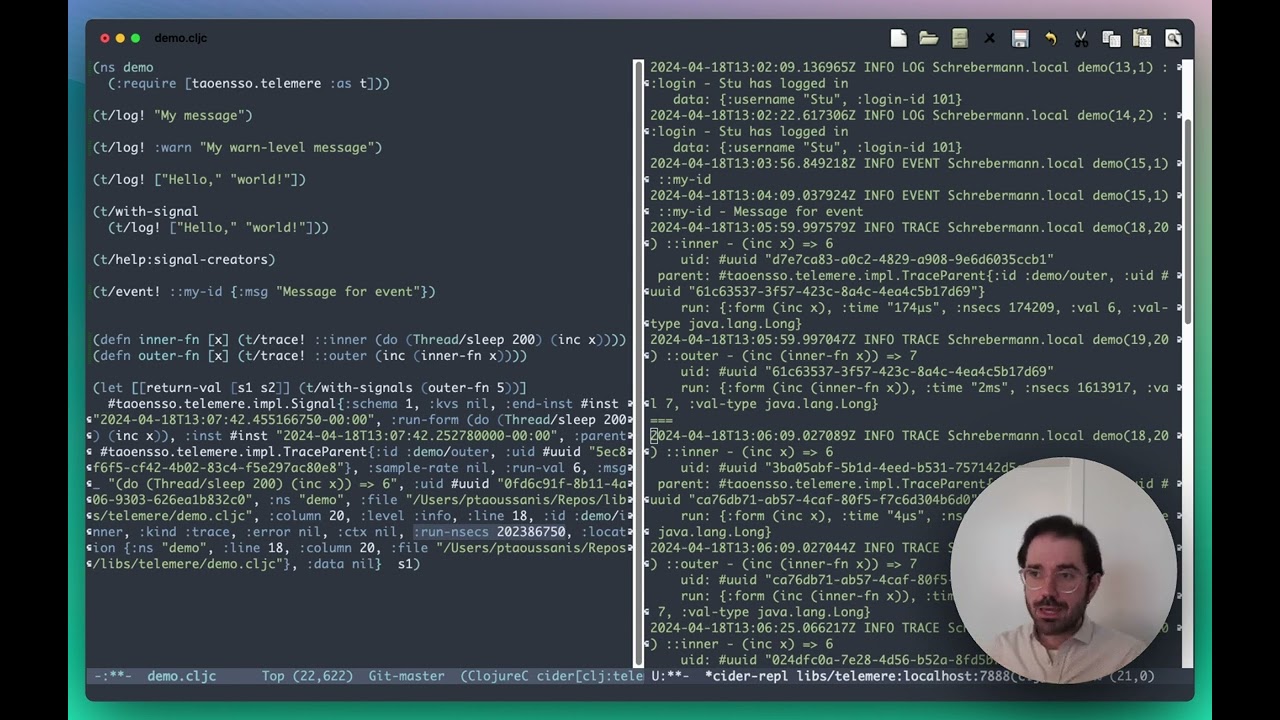
Video demo
See for intro and basic usage:
Quick examples
(require '[taoensso.telemere :as t])

(t/log! {:id ::my-id, :data {:x1 :x2}} "My message") %>

;; 2024-04-11T10:54:57.202869Z INFO LOG Schrebermann.local examples(56,1) ::my-id - My message
;;    data: {:x1 :x2}

(t/log!       "This will send a `:log` signal to the Clj/s console")
(t/log! :info "This will do the same, but only when the current level is >= `:info`")

;; Easily construct messages from parts
(t/log! :info ["Here's a" "joined" "message!"])

;; Attach an id
(t/log! {:level :info, :id ::my-id} "This signal has an id")

;; Attach arb user data
(t/log! {:level :info, :data {:x :y}} "This signal has structured data")

;; Capture for debug/testing
(t/with-signal (t/log! "This will be captured"))
;; => {:keys [location level id data msg_ ...]}

;; `:let` bindings are available to `:data` and message, but only paid
;; for when allowed by minimum level and other filtering criteria
(t/log!
  {:level :info
   :let [expensive-metric1 (last (for [x (range 100), y (range 100)] (* x y)))]
   :data {:metric1 expensive-metric1}}
  ["Message with metric value:" expensive-metric1])

;; With sampling 50% and 1/sec rate limiting
(t/log!
  {:sample-rate 0.5
   :rate-limit  {"1 per sec" [1 1000]}}
  "This signal will be sampled and rate limited")

;; There are several signal creators available for convenience.
;; All support the same options but each offer's a calling API
;; optimized for a particular use case. Compare:

;; `log!` - [msg] or [level-or-opts msg]
(t/with-signal (t/log! {:level :info, :id ::my-id} "Hi!"))

;; `event!` - [id] or [id level-or-opts]
(t/with-signal (t/event! ::my-id {:level :info, :msg "Hi!"}))

;; `signal!` - [opts]
(t/with-signal (t/signal! {:level :info, :id ::my-id, :msg "Hi!"}))

;; See `t/help:signal-creators` docstring for more

;;; A quick taste of filtering

(t/set-ns-filter! {:disallow "taoensso.*" :allow "taoensso.sente.*"})
(t/set-id-filter! {:allow #{::my-particular-id "my-app/*"}})

(t/set-min-level!       :warn) ; Set minimum level for all    signals
(t/set-min-level! :log :debug) ; Set minimul level for `log!` signals

;; Set minimum level for `event!` signals originating in
;; the "taoensso.sente.*" ns
(t/set-min-level! :event "taoensso.sente.*" :warn)

;; See `t/help:filters` docstring for more

;;; Use middleware to transform signals and/or filter signals
;;; by signal data/content/etc.

(t/set-middleware!
  (fn [signal]
    (if (get-in signal [:data :hide-me?])
      nil ; Suppress signal (don't handle)
      (assoc signal :passed-through-middleware? true))))

(t/with-signal (t/event! ::my-id {:data {:hide-me? true}}))  ; => nil
(t/with-signal (t/event! ::my-id {:data {:hide-me? false}})) ; => {...}
See examples.cljc for more REPL-ready snippets!
API overview
See relevant docstrings (links below) for usage info-
Creating signals
| Name | Signal kind | Main arg | Optional arg | Returns |
|---|---|---|---|---|
log! |
:log |
msg |
opts/level |
Signal allowed? |
event! |
:event |
id |
opts/level |
Signal allowed? |
error! |
:error |
error |
opts/id |
Given error |
trace! |
:trace |
form |
opts/id |
Form result |
spy! |
:spy |
form |
opts/level |
Form result |
catch->error! |
:error |
form |
opts/id |
Form value or given fallback |
signal! |
<arb> |
opts |
- | Depends on opts |
Internal help
Detailed help is available without leaving your IDE:
| Var | Help with |
|---|---|
help:signal-creators |
Creating signals |
help:signal-options |
Options when creating signals |
help:signal-content |
Signal content (map given to middleware/handlers) |
help:filters |
Signal filtering and transformation |
help:handlers |
Signal handler management |
help:handler-dispatch-options |
Signal handler dispatch options |
help:environmental-config |
Config via JVM properties, environment variables, or classpath resources. |
Included handlers
See linked docstrings below for features and usage:
| Name | Platform | Output target | Output format |
|---|---|---|---|
handler:console |
Clj | *out* or *err* |
edn/JSON or human-readable |
handler:console |
Cljs | Browser console | edn/JSON or human-readable |
handler:console-raw |
Cljs | Browser console | Raw signals for cljs-devtools, etc. |
handler:file |
Clj | File/s on disk | edn/JSON or human-readable |
handler:open-telemetry-logger |
Clj | OpenTelemetry Java client | LogRecord |
handler:postal |
Clj | Email (via postal) | edn/JSON or human-readable |
handler:slack |
Clj | Slack (via clj-slack) | edn/JSON or human-readable |
handler:tcp-socket |
Clj | TCP socket | edn/JSON or human-readable |
handler:udp-socket |
Clj | UDP socket | edn/JSON or human-readable |
See here for more/upcoming handlers, community handlers, info on writing your own handlers, etc.
Documentation
- Wiki (getting started, usage, etc.)
- API reference: cljdoc or Codox
- Support: Slack channel or GitHub issues
- General observability tips (advice on building and maintaining observable Clojure/Script systems, and getting the most out of Telemere)
Benchmarks
Telemere is highly optimized and offers terrific performance at any scale:
| Compile-time filtering? | Runtime filtering? | Time? | Trace? | nsecs |
|---|---|---|---|---|
| ✓ (elide) | - | - | - | 0 |
| - | ✓ | - | - | 200 |
| - | ✓ | ✓ | - | 280 |
| - | ✓ | ✓ | ✓ | 650 |
Measurements:
- Are ~nanoseconds per signal call (= milliseconds per 1e6 calls)
- Exclude handler runtime (which depends on handler/s, is usually async)
- Taken on a 2020 Macbook Pro M1, running OpenJDK 21
Tip: Telemere offers extensive filtering support - including dead-easy per-signal and per-handler sampling and rate-limiting. Use these to ensure that you're not capturing useless/low-value information in production. See here for more tips!
Funding
You can help support continued work on this project, thank you!! 🙏
License
Copyright © 2023-2024 Peter Taoussanis.
Licensed under EPL 1.0 (same as Clojure).