 ffea1a30ed
Thanks to @AdamFrey for reporting this issue! Ref. <https://clojurians.slack.com/archives/C06ALA6EEUA/p1713805333272469> Previously: Attempting to run AOT'd code using Telemere would result in errors like: "Attempting to call unbound fn: #'taoensso.telemere.handlers.open-telemetry/handler:open-telemetry-logger" The approach I was using of conditionally requiring namespaces and then aliasing vars seems to be inherently fragile under AOT, and was leading to the remote source var being unbound. With this commit I've now switched to a simpler approach - where we conditionally require namespaces *without* the need for any aliasing. |
||
|---|---|---|
| .github/workflows | ||
| bb | ||
| doc | ||
| imgs | ||
| public | ||
| resources/signal-docstrings | ||
| slf4j | ||
| src/taoensso | ||
| test/taoensso | ||
| wiki | ||
| .gitignore | ||
| bb.edn | ||
| CHANGELOG.md | ||
| examples.cljc | ||
| FUNDING.yml | ||
| LICENSE.txt | ||
| project.clj | ||
| README.md | ||
| SECURITY.md | ||
| shadow-cljs.edn | ||
| shadow-cljs.sh | ||

Documentation | Latest releases | Slack channel

Structured telemetry library for Clojure/Script
Telemere is a next-generation replacement for Timbre. It handles structured and traditional logging, tracing, and basic performance monitoring with a simple unified API.
It helps enable Clojure/Script systems that are observable, robust, and debuggable - and it represents the refinement and culmination of ideas brewing over 12+ years in Timbre, Tufte, Truss, etc.
[Terminology] Telemetry derives from the Greek tele (remote) and metron (measure). It refers to the collection of in situ (in position) data, for transmission to other systems for monitoring/analysis. Logs are the most common form of software telemetry. So think of telemetry as the superset of logging-like activities that help monitor and understand (software) systems.
Latest release/s
v1.0.0-beta1: release info


See here for earlier releases.
Why Telemere?
Ergonomics
- Elegant, lightweight API that's easy to use, easy to configure, and deeply flexible.
- Sensible defaults to make getting started fast and easy.
- Extensive beginner-oriented documentation, docstrings, and error messages.
Interop
- 1st-class out-the-box interop with SLF4J v2, clojure.tools.logging, OpenTelemetry, and Tufte.
- Included shim for easy/gradual migration from Timbre.
Scaling
- Hyper-optimized and blazing fast, see benchmarks.
- An API that scales comfortably from the smallest disposable code, to the most massive and complex real-world production environments.
Flexibility
- Config via plain Clojure vals and fns for easy customization, composition, and REPL debugging.
- Unmatched support for system-level config (JVM props, ENV vars, classpath resources).
- Expressive per-call and per-handler filtering at both runtime and compile-time.
- Filter by namespace and id pattern, level, level by namespace pattern, etc.
- Sampling, rate-limiting, and back-pressure monitoring.
- Fully configurable a/sync dispatch (blocking, dropping, sliding, etc.).
Video demo
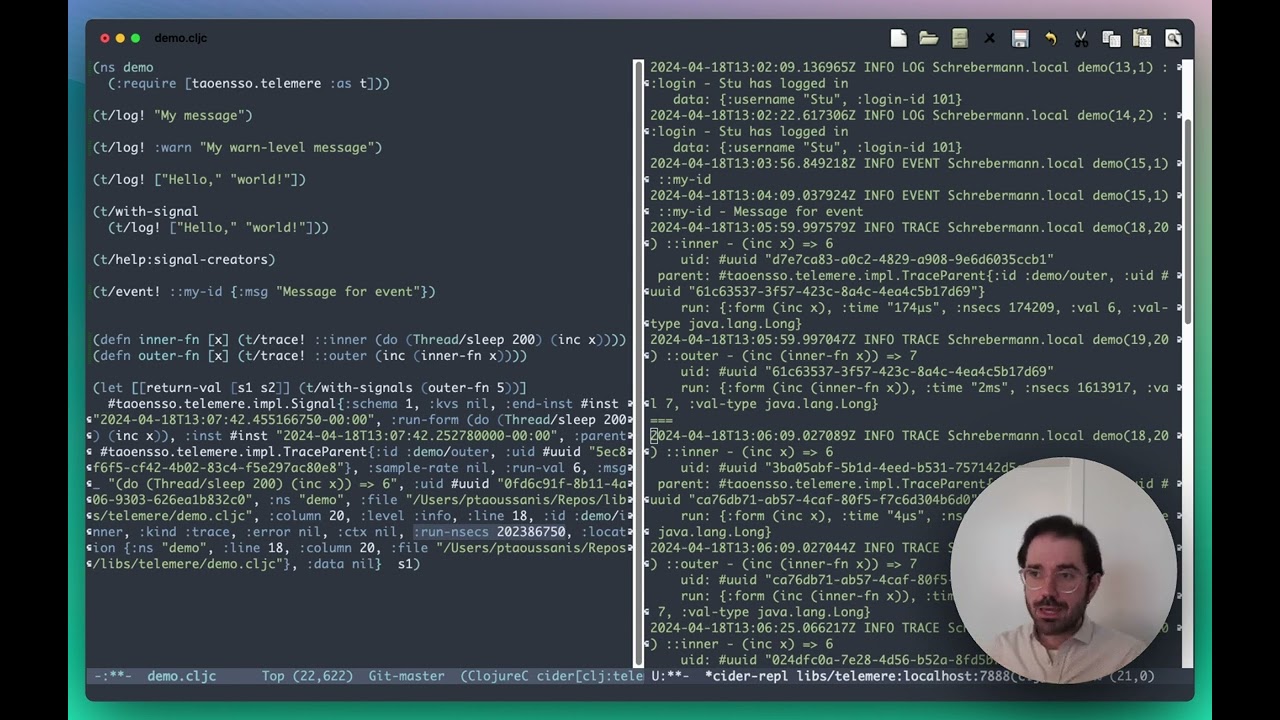
See for intro and usage:
Quick examples
(require '[taoensso.telemere :as t])

;; Start simple
(t/log! "This will send a `:log` signal to the Clj/s console")
(t/log! :info "This will do the same, but only when the current level is >= `:info`")

;; Easily construct messages
(let [x "constructed"] (t/log! :info ["Here's a" x "message!"]))

;; Attach an id
(t/log! {:level :info, :id ::my-id} "This signal has an id")

;; Attach arb user data
(t/log! {:level :info, :data {:x :y}} "This signal has structured data")

;; Capture for debug/testing
(t/with-signal (t/log! "This will be captured"))
;; => {:keys [location level id data msg_ ...]}

;; `:let` bindings available to `:data` and message, only paid for
;; when allowed by minimum level and other filtering criteria
(t/log!
  {:level :info
   :let [expensive-metric1 (last (for [x (range 100), y (range 100)] (* x y)))]
   :data {:metric1 expensive-metric1}}
  ["Message with metric value:" expensive-metric1])

;; With sampling 50% and 1/sec rate limiting
(t/log!
  {:sample-rate 0.5
   :rate-limit  {"1 per sec" [1 1000]}}
  "This signal will be sampled and rate limited")

;;; A quick taste of filtering...

(t/set-ns-filter! {:deny "taoensso.*" :allow "taoensso.sente.*"}) ; Set namespace filter
(t/set-id-filter! {:allow #{::my-particular-id "my-app/*"}})      ; Set id        filter

(t/set-min-level!       :warn) ; Set minimum level
(t/set-min-level! :log :debug) ; Set minimul level for `:log` signals

;; Set minimum level for `:event` signals originating in the "taoensso.sente.*" ns
(t/set-min-level! :event "taoensso.sente.*" :warn)
See examples.cljc for more REPL-ready snippets.
API overview
See relevant docstrings (links below) for usage info-
Signal creators
| Name | Signal kind | Main arg | Optional arg | Returns |
|---|---|---|---|---|
log! |
:log |
msg |
opts/level |
Signal allowed? |
event! |
:event |
id |
opts/level |
Signal allowed? |
error! |
:error |
error |
opts/id |
Given error |
trace! |
:trace |
form |
opts/id |
Form result |
spy! |
:spy |
form |
opts/level |
Form result |
catch->error! |
:error |
form |
opts/id |
Form value or given fallback |
signal! |
<arb> |
opts |
- | Depends on opts |
Signal filters
| Global | Dynamic | Filters by |
|---|---|---|
set-kind-filter! |
with-kind-filter |
Signal kind (:log, :event, etc.) |
set-ns-filter! |
with-ns-filter |
Signal namespace |
set-id-filter! |
with-id-filter |
Signal id |
set-min-level |
with-min-level |
Signal level (minimum can be specified by kind and/or ns) |
Internal help
| Var | Help with |
|---|---|
help:signal-creators |
List of signal creators |
help:signal-options |
Options for signal creators |
help:signal-content |
Signal map content |
help:signal-flow |
Ordered flow from signal creation to handling |
help:signal-filters |
API for configuring signal filters |
help:signal-handlers |
API for configuring signal handlers |
help:signal-formatters |
Signal formatters for use by handlers |
Example handler output
(t/log! {:id ::my-id, :data {:x1 :x2}} "My message") =>
Clj console handler
String output:
2024-04-11T10:54:57.202869Z INFO LOG Schrebermann.local examples(56,1) ::my-id - My message
    data: {:x1 :x2}
Cljs console handler
Chrome console:

Cljs raw console handler
Chrome console, with cljs-devtools:

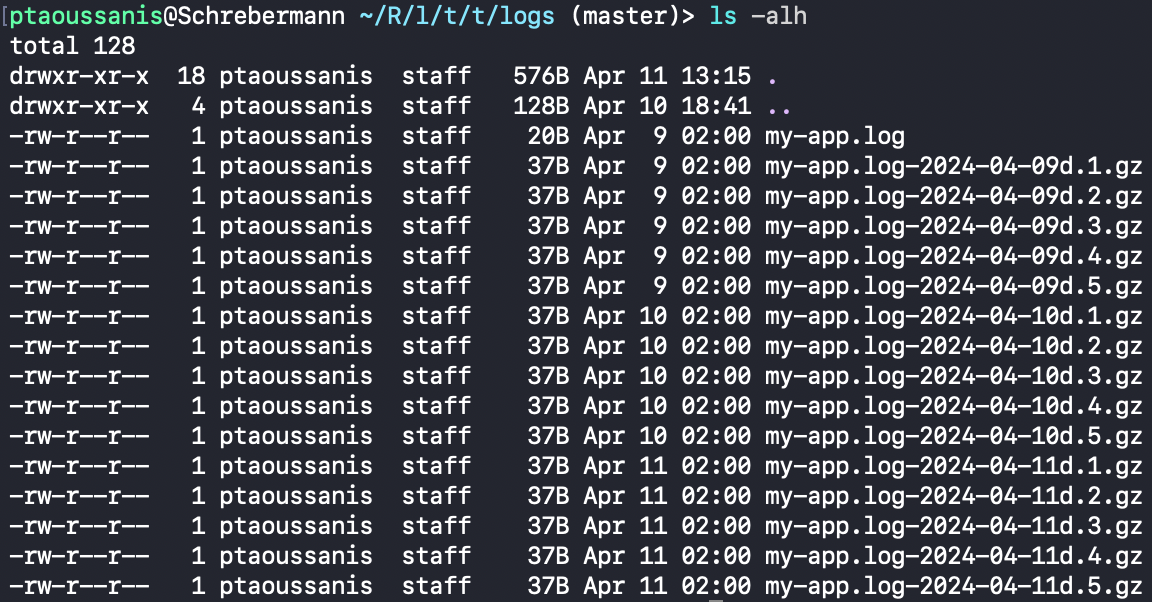
Clj file handler
MacOS terminal:
Documentation
- Wiki (getting started, usage, etc.)
- API reference: cljdoc or Codox
- Support: Slack channel or GitHub issues
Observability tips
See here for general advice re: building and maintaining observable Clojure/Script systems.
Benchmarks
Telemere is highly optimized and offers terrific performance at any scale:
| Compile-time filtering? | Runtime filtering? | Time? | Trace? | nsecs |
|---|---|---|---|---|
| ✓ (elide) | - | - | - | 0 |
| - | ✓ | - | - | 200 |
| - | ✓ | ✓ | - | 280 |
| - | ✓ | ✓ | ✓ | 650 |
Measurements:
- Are ~nanoseconds per signal call (= milliseconds per 1e6 calls)
- Exclude handler runtime (which depends on handler/s, is usually async)
- Taken on a 2020 Macbook Pro M1, running OpenJDK 21
Tip: Telemere offers extensive per-call and per-handler filtering, sampling, and rate-limiting. Use these to ensure that you're not capturing useless/low-value information in production. See here for more tips!
Funding
You can help support continued work on this project, thank you!! 🙏
License
Copyright © 2023-2024 Peter Taoussanis.
Licensed under EPL 1.0 (same as Clojure).