
4.6 KiB
Contributing
CI
Most of D2's CI is open sourced in its own
repository. You can find commands in the Github
workflows. E.g. run ./make.sh fmt to run the formatter. Please make sure all CI is
passing for any PRs.
Most of the CI scripts rely on a submodule shared between many D2 repositories: https://github.com/terrastruct/ci. You should fetch the submodule whenever it differs:
git submodule update --recursive
If running for the first time for a repo (e.g. new clone), add --init:
git submodule update --init --recursive
Flow
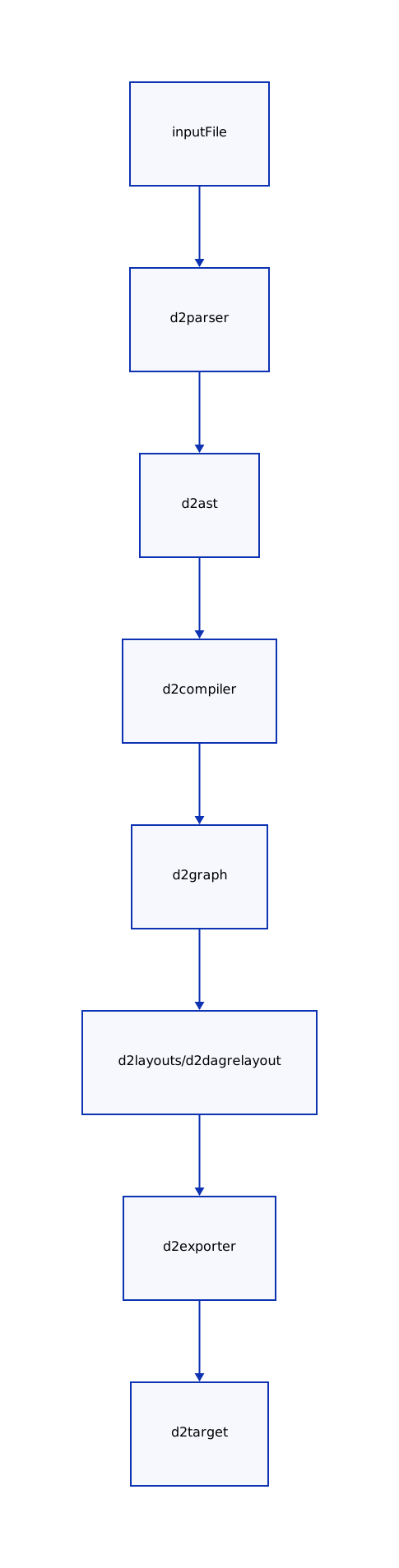
The simplified D2 flow at a package level looks like:
Logistics
- Use Go 1.18. Go 1.19's autofmt inexplicably strips spacing from ASCII art in comments.
- Please sign your commits (https://github.com/terrastruct/d2/pull/557#issuecomment-1367468730).
- D2 uses Issues as TODOs. No auto-closing on staleness.
- Branch off
master. - Prefix pull request titles with a short descriptor of the domain, e.g.
d2renderer: Add x. - If there's an Issue related, include it by adding "[one-word] #[issue]", e.g. "Fixes #123" somewhere in the description.
- Whenever possible and relevant, include a screenshot or screen-recording.
Dev
Content
Please choose an Issue with a "TODO" label. If you'd like to propose new functionality or change to current functionality, please create an Issue first with a proposal. When you start work on an Issue, please leave a comment so others know that it's being worked on.
Tests
All code changes must include tests. D2 mostly has functional tests, and uses diff as a framework that gives Git-style comparisons of expected vs actual output for each stage. There are ample examples in each package of this -- try changing some test and run it to see.
With the exception of changes to the renderer, all code should include a package-specific test. If it's a visual change, an e2e test should accompany.
If you're testing labels and strings, it's encouraged to use 1-letter strings (x) in small
functional tests to minimally pinpoint issues. If you are testing something that exercises
variations in strings, or want to mimic more realistic diagram text, it's encouraged you
generate random strings and words from fortune. It gives a good range of the English
language. Sometimes it gives controversial sentences -- don't use those.
Script to generate one line of random text:
ipsum1() {
  fortune | head -n1 | sed 's/^ *//;s/ *$//' | tr -d '\n' | tee /dev/stderr | pbcopy
}
Running tests
Run: ./ci/test.sh
CI runs tests with -race to catch potential race conditions. It's much slower, but if
your machine can run it locally, you can do so with ./make.sh race.
If you add a new test and run, it will show failure. That's because the vast majority of
D2's tests are comparing outputs. You don't define the expected output manually. The
testing library generates it and it's checked into version control if it looks right. So
for the first run of a new test, it has no expected output, and will fail. To accept the
result as the expected, run the test with environment variable TESTDATA_ACCEPT=1.
Chaos tests
D2 has chaos tests which produce random configurations of diagrams. It can be helpful to run a few iterations (N~=100) to spot cover your manual tests.
D2_CHAOS_MAXI=100 D2_CHAOS_N=100 ./ci/test.sh ./d2chaos
Documentation
The code itself should be documented as appropriate with Go-style comments. No rules here,
GetX() doesn't need a // GetX gets X.
If it's some new functionality, please submit a pull request to document it in the language docs: https://github.com/terrastruct/d2-docs.
Questions
If you have any questions or would like to get more involved, feel free to open an issue to discuss publicly, or chat in Discord! If you have a private inquiry, feel free to email us at hi@d2lang.com.