
5.2 KiB
Creating Reloadable Uberjar'able App
App state
Here is an example app that has these states:
16:20:44.997 [nREPL-worker-0] INFO  mount - >> starting..  app-config
16:20:44.998 [nREPL-worker-0] INFO  mount - >> starting..  conn
16:20:45.393 [nREPL-worker-0] INFO  mount - >> starting..  nyse-app
16:20:45.443 [nREPL-worker-0] INFO  mount - >> starting..  nrepl
where nyse-app is the app. It has the usual routes:
(defroutes mount-example-routes

  (GET "/" [] "welcome to mount sample app!")
  (GET "/nyse/orders/:ticker" [ticker]
       (generate-string (find-orders ticker)))

  (POST "/nyse/orders" [ticker qty bid offer]
        (add-order ticker (bigdec bid) (bigdec offer) (Integer/parseInt qty))
        (generate-string {:added {:ticker ticker
                                  :qty qty
                                  :bid bid
                                  :offer offer}})))
and the reloadable state:
(defn start-nyse []
  (create-nyse-schema)                      ;; creating schema (usually done long before the app is started..)
  (-> (routes mount-example-routes)
      (handler/site)
      (run-jetty {:join? false
                  :port (get-in app-config [:www :port])})))

(defstate nyse-app :start (start-nyse)
                   :stop (.stop nyse-app))  ;; it's a "org.eclipse.jetty.server.Server" at this point
In order not to block, and being reloadable, the Jetty server is started in the ":join? false" mode which starts the server,
and just returns a reference to it, so it can be easily stopped by (.stop server)
"Uberjar is the :main"
In order for a standalone jar to run, it needs an entry point. This sample app has one:
;; example of an app entry point
(defn -main [& args]
  (mount/start))
And some usual suspects from project.clj:
;; "test" is in sources here to just "demo" the uberjar without poluting mount "src"
:uberjar {:source-paths ["test/app"]
          :dependencies [[compojure "1.4.0"]
                          [ring/ring-jetty-adapter "1.1.0"]
                          [cheshire "5.5.0"]
                          [org.clojure/tools.nrepl "0.2.11"]
                          [com.datomic/datomic-free "0.9.5327" :exclusions [joda-time]]]
          :main app
          :aot :all}}
REPL time
$ lein do clean, repl

user=> (dev)(reset)
16:20:44.997 [nREPL-worker-0] INFO  mount - >> starting..  app-config
16:20:44.998 [nREPL-worker-0] INFO  mount - >> starting..  conn
16:20:45.393 [nREPL-worker-0] INFO  mount - >> starting..  nyse-app

16:20:45.442 [nREPL-worker-0] INFO  o.e.jetty.server.AbstractConnector - Started SelectChannelConnector@0.0.0.0:53600

16:20:45.443 [nREPL-worker-0] INFO  mount - >> starting..  nrepl
:ready
dev=>
Jetty server is started and ready to roll. And everything is still restartable:
user=> (reset)
16:44:16.625 [nREPL-worker-2] INFO  mount - << stopping..  nrepl
16:44:16.626 [nREPL-worker-2] INFO  mount - << stopping..  nyse-app
16:44:16.711 [nREPL-worker-2] INFO  mount - << stopping..  conn
16:44:16.713 [nREPL-worker-2] INFO  mount - << stopping..  app-config

16:44:16.747 [nREPL-worker-2] INFO  mount - >> starting..  app-config
16:44:16.748 [nREPL-worker-2] INFO  mount - >> starting..  conn
16:44:16.773 [nREPL-worker-2] INFO  mount - >> starting..  nyse-app

16:44:16.777 [nREPL-worker-2] INFO  o.e.jetty.server.AbstractConnector - Started SelectChannelConnector@0.0.0.0:54476

16:44:16.778 [nREPL-worker-2] INFO  mount - >> starting..  nrepl
Notice the Jetty port difference between reloads: 53600 vs. 54476. This is done on purpose via config:
:www {:port 0} ;; Jetty will randomly assign the available port (this is good for dev reloadability)
This of course can be solidified for different env deployments. For example I like 4242 :)
Packaging one super uber jar
$ lein do clean, uberjar
...
Created /Users/tolitius/1/fun/mount/target/mount-0.1.0-SNAPSHOT-standalone.jar ;;  your version may vary
Let's give it a spin:
$ java -jar target/mount-0.1.0-SNAPSHOT-standalone.jar
...
16:51:35.586 [main] DEBUG o.e.j.u.component.AbstractLifeCycle - STARTED SelectChannelConnector@0.0.0.0:54728
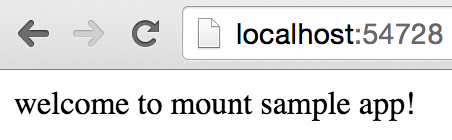
Up and running on port :54728:
See if we have any orders:

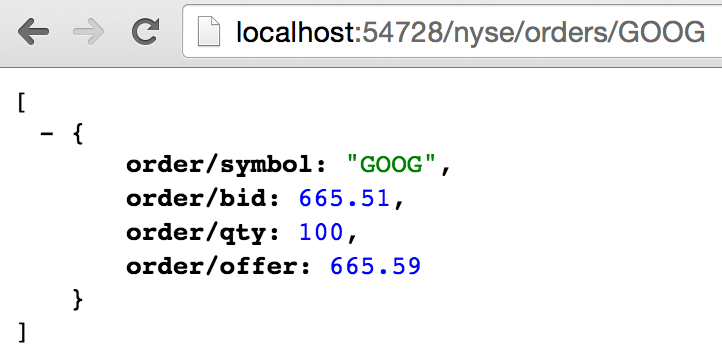
we don't. let's put something into Datomic:
$ curl -X POST -d "ticker=GOOG&qty=100&bid=665.51&offer=665.59" "http://localhost:54728/nyse/orders"
{"added":{"ticker":"GOOG","qty":"100","bid":"665.51","offer":"665.59"}}
now we should:
Choices
There are multiple ways to start a web app. This above is the most straighforward one: start server / stop server.
But depending on the requirements / architecture, the app can also have an entry point to (mount/start)
via something like :ring :init). Or the (mount/start)
can go into the handler function, etc.